
The European Union was supposed to be a utopia, one that welcomes open borders, minority religions and races, wealth re-distribution, and generous welfare policies. But lately, the “European project” has turned sour after experiencing a refugee crisis, stagnating economies, and opposition from both the US and Russia.
A pro-EU think tank named the European Council on Foreign Relations (ECFR) conducted a study on how Europeans actually felt about the EU. Most shocking is that 30% of respondents believed war was possible between EU nations.
War felt likely since the EU’s hegemony over individual states is held almost solely (de-facto-wise) by German Chancellor Angela Merkel and her liberalism. In the chart below, France and Poland are the most worried about war since they share the longest borders with Germany. “Members, especially the smaller EU states, were frightened by how forcefully Merkel tried to make them take migrants,” stated geopolitical analyst Mark Davidson, “it reminded them of Germany’s forceful demands of the late 1930’s.”

The ECFR study noted that in “Austria, Germany, and Greece – all countries with a high per capita intake of migrants since 2015 – [war] was perceived as at least as much of a threat as immigration”.
That’s because respondents stated that endless migration can lead to war since resources will be scarcer and inflation will soar. And it certainly doesn’t help that Europeans are historically divided on foreign policy. Memories of World War I and II were drawn.
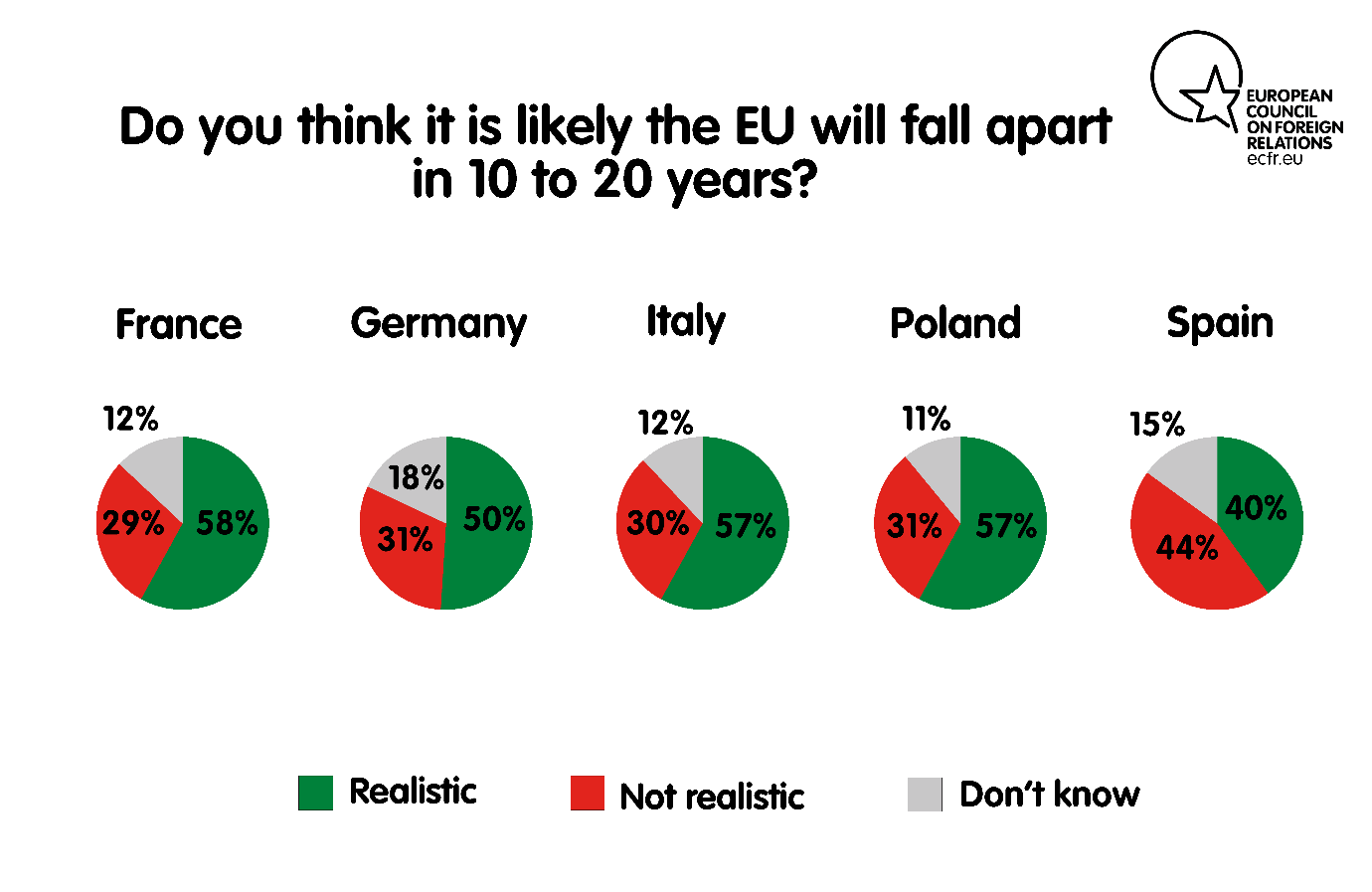
Next, on the very survival of the EU itself, it’s not surprising that France is the most pessimistic, which is depicted on the diagram below. French President Emmanuel Macron’s leftist agenda was initially meet with applause since he campaigned on “opposing Trump and embracing pan-European values”. However, his ratings sunk as yellow jacket protests sprung against his mismanagement of France’s economy.
Likewise, the United Kingdom was caught off-guard by the Brexit vote in 2016. The complacent pro-EU establishment, led by Former Prime Minister David Cameron, only held a referendum because they expected the slient majority to embrace their “values”.
For Germany, Austria, and Hungary, voters are turning to outcast parties, such as Germany’s Alternative for Deutschland (AfD) and Hungary’s Fidesz, to stem the follow of migrants. Poland took a step further by ignoring laws passed by the EU in Brussels, including pro-migrant and anti-abortion ones, in favor of traditional Christianity.
The study effectively summarized European feelings when it stated that “in almost all countries ECFR surveyed, a majority of people felt their children’s lives would be worse than their own”.
 American Post